Apparatus
WebGL is unavailable on this device.
Drag to orbit · scroll to zoom
Lens → concave mirrorMirror → comparator → eyeAll lengths in metres
Measuring the starting apparatus…
The subject patch is sampled on three planes at the reference distance and the chosen depth offsets. Each point is found by solving actual reverse rays through the plano-convex lens, spherical primary and comparator. The analysis uses 24 pupil samples and nine head poses per point. A point passes when pupil clearance is at least 75%, RMS blur is within the chosen limit, and all head poses resolve within the drift limit. Unresolved samples may be clipped or beyond the numerical solver’s reach.
Head drift tracks the same subject point against a fixed mark on the physical canvas. This is geometric registration, independent of the eye-preview framing. The depth plot uses two local principal ray-fan conjugates; their separation includes astigmatism. Aligning one point does not flatten the whole scene. The field/depth fit minimises summed squared head displacement over points with full head paths and at least 75% pupil clearance; it is a compromise, not a global apparatus optimisation.
These are test planes, not intersections with the room furniture. The calibration board has an asymmetric F, fine bars and grey patches. Red and blue beads lie in front of and behind it; the far bead is viewed through a hole. The room, hardware supports and lighting remain illustrative. The predicted footprint bounds contain only passing sampled points and do not certify a continuous usable rectangle.
Canvas light is a relative illumination multiplier. Matching uses mean optical transmission at the selected point, assuming identical diffuse white references under equal incident illumination. Mirror reflectances are editable scalar assumptions. This does not model colour dispersion, coating spectra, glare, diffraction, real sunlight changes or physiological vision. All plots use the current optical parameters and become stale when the setup changes.
The eye image traces rays through the actual flat and spherical lens surfaces, concave mirror and comparator. Flip the lens to compare aberrations. The aperture is a separate stop, and rays that miss the glass or stop are rejected. Each pass adds eight samples across one pupil; the image refines when controls are stationary. Changes restart the accumulation. Display exposure is applied afterwards.
The apparatus view is an inspection rendering, with the same lens shape and component positions. Its glass shading is illustrative; the comparator eye image is the optical calculation. This is geometric optics with a single refractive index: spectral dispersion, diffraction and internal reflection paths are not included. The painting study adds relative canvas illumination and assumed mirror reflectances; the room lighting is still illustrative.
The table and adjustable supports follow Tim’s 7 September 2011 drawing. Hardware dimensions and the unobstructed offset alignment remain assumptions. The drawing labels the comparator at 45°; use the centred comparison preset to inspect that arrangement.
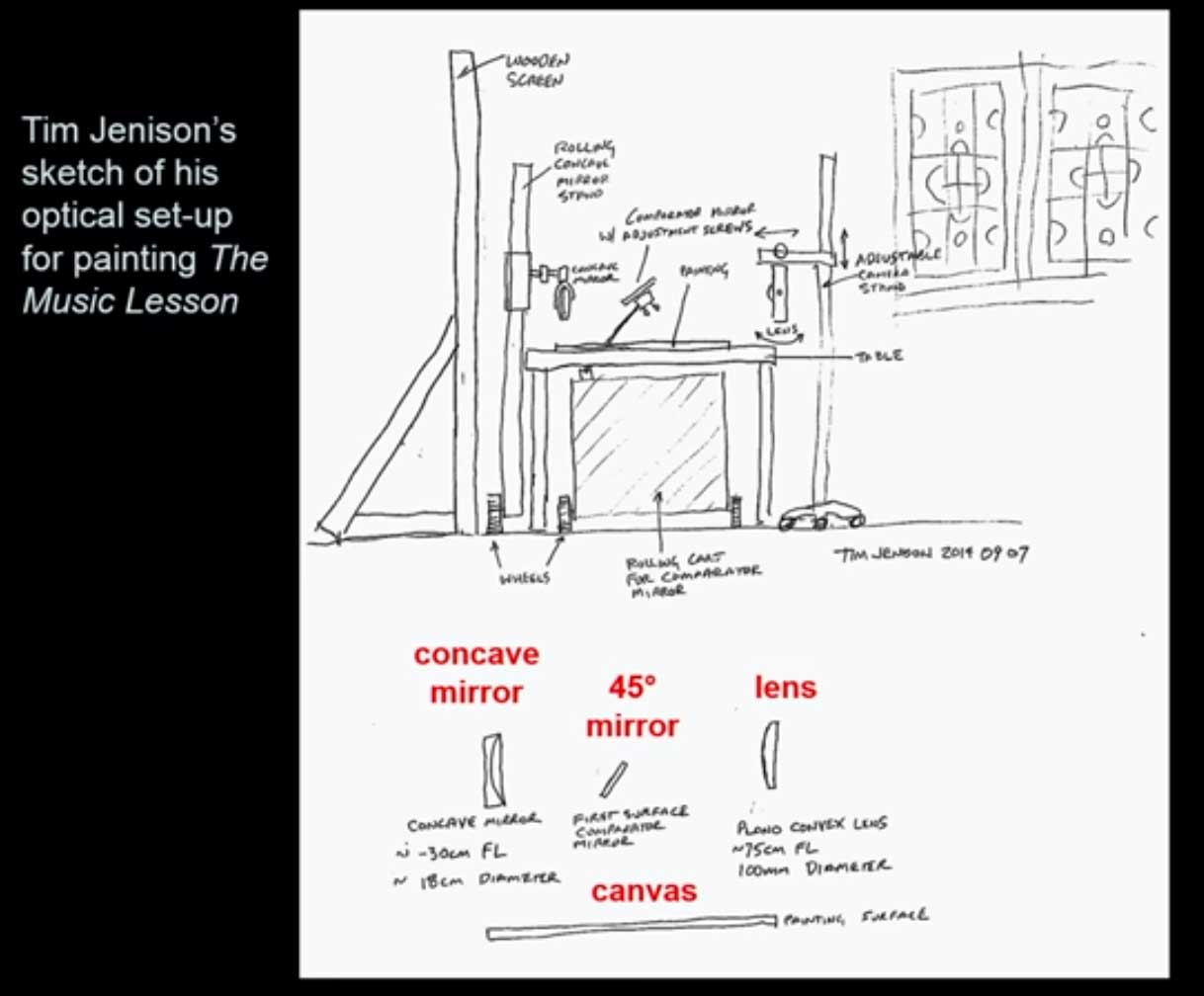
Correspondence update: on 14 November 2017 Tim offered a 710 mm lens like the one used in the film. The paper gives approximately 750 mm. The starting setting retains the paper’s value; the “Tim’s film-type lens” button applies the correspondence value. Tim’s 2011 drawing confirms a plano-convex lens, approximately 750 mm focal length and 100 mm diameter. Thickness and refractive index remain adjustable assumptions.
This is an optical prototype, with a simplified room and furniture. It is not yet a metrically verified reconstruction of The Music Lesson.
| Parameter | Starting value | Evidence |
|---|---|---|
| Lens | 100 mm aperture; 750 mm EFL | Stork, Tyler & Schechner, Figure 1 |
| Concave mirror | 180 mm aperture; 300 mm focal length | Same paper; radius magnitude 600 mm |
| Comparator | 50.8 × 101.6 mm; starts at 37° | Size from contemporary description; tilt adjusted for the assumed offset return path |
| Offset alignment | Concave mirror tilted 8°; comparator 90 mm above lens axis | Working unobstructed arrangement; not a measured reconstruction of Tim’s rig |
| Room length | 6.5 m | Steadman’s published summary |
| Room width / height | 5.36 / 4.40 m | Provisional; verify against the book |
| Lens prescription | Plano-convex; 8 mm centre thickness; n = 1.52 | Assumed, derived to match EFL; original unknown |
| Separations / scene placement | Editable starting geometry | Assumed; Figure 1 is schematic and has no scale bar |
The eye view traces backwards through a finite pupil, the plane comparator, an analytic spherical mirror and flat/spherical lens surfaces using Snell’s law. Optical reversibility gives the same paths as forwards tracing. Apertures, first-pass comparator obstruction, total internal reflection and unpolarised Fresnel transmission are included. Display exposure is relative. The calibration target has defined reflectances and editable scalar mirror losses; room materials and daylight remain illustrative, not calibrated measurements. The eye uses an ideal focused camera model. No diffraction, measured spectral dispersion, coating interference, lens defects, ghost reflections, or physiological eye model are included.
The dark area can be a real missed optical path. Changing alignments can remove the image completely. All blue rays terminate at the same single eye point. The eight samples per pixel per pass in the eye image are samples across that one pupil, not separate eyes. The comparator must intercept the returning beam, while clearing the incoming beam where possible. The starting arrangement tilts the concave mirror 8° and raises the comparator 90 mm above the lens axis to separate these paths. Its side post and upper support arm avoid the incident beam. The guide-ray obstruction count samples an on-axis scene point; it is not a guarantee of clearance for every field angle. The coloured apparatus rays are monochromatic geometry samples; colours identify path stages, not wavelengths. Canvas height and eye focus must agree with the relayed image distance for low parallax and sharp comparison.
Stork, Tyler & Schechner (2020), Fig. 1 and §2.1 · Steadman, Chapter 5 · Steadman, room length · Comparator dimensions
The Delft dark-room scene now simulates the lens–screen arrangement separately. The Tasmania reflex box remains a configuration for later development.
| Arrangement | Optics | Working setup |
|---|---|---|
| View of Delft | 1500 mm lens; usually 84 mm aperture (f/17.8); 254 × 254 mm projection screen; no concave mirror | Vertical canvas; 50.8 × 101.6 mm comparator; eye about 200 mm from canvas |
| Tasmania reflex box | 100 mm magnifying lens, about 305 mm focal length; usually 50 mm aperture; internal 45° plane mirror | Vertical screen; 45° comparator; horizontal canvas; 6.35 mm plywood box |
For Delft, Tim describes a temporary dark-room building with the lens about 4 m above ground in the north wall. A separate north-facing window and adjustable shutter lit the canvas; flags kept this light off the projection screen. The canvas, screen, lens and comparator were moved to centre the current subject. These light-control principles are useful for a future container room. The messages found do not give building dimensions or explicitly call the building a shipping container.
He also sent a raster CAD drawing of an iris blade, preserved with the project’s research notes. The original messages are 14 November 2017 and 7 December 2017.